Smart Home Battery Backup Guide
Smart Home Battery Backup: Why a Dead Grid Shouldn’t Kill Your Automations
When the power goes out, your smart home becomes a dumb house. Locks stop responding to automations, cameras go dark, thermostats revert to manual control, and every routine you spent hours building just dies. A proper smart home battery backup keeps everything running — and in 2026, you don’t need a $10,000 solar installation or a whole-house generator to make it happen.
According to CISA’s power outage preparedness guidance, the average US home experiences 1-2 significant outages per year, with some regions hitting 5-8 due to aging grid infrastructure and severe weather. If your automations are worth building, they’re worth keeping alive through the outages that tend to happen at the worst possible moments.

What Actually Needs Backup Power in Your Smart Home
Not everything in your smart home needs battery backup. Running your refrigerator or air conditioning on battery power is expensive and unnecessary. Here’s the realistic priority stack for smart home continuity:
- Modem and router — If your network dies, nothing smart works. Period. This is non-negotiable. Budget 15-30W total for a typical cable modem and WiFi router combo, or slightly more if you’re running a separate router and mesh system.
- Smart home hub or server — Whether you’re running Home Assistant on a mini PC, SmartThings on a hub, or Hubitat, the automation brain needs power to process triggers and maintain schedules.
- Network switch — If you have wired devices or a PoE switch powering cameras and access points, the switch needs to stay up. Managed switches typically draw 10-20W.
- NAS and local servers — Your NAS, Pi-hole, Docker containers, and any local services should stay up. More importantly, they need a clean shutdown path when battery runs low — an unclean power loss can corrupt data.
- Security cameras — Cameras are most useful during the exact situations that cause power outages. Keeping them running isn’t just convenient, it’s a security concern.
- Smart locks and sensors — Most battery-powered locks and Zigbee/Z-Wave sensors run fine on their own internal batteries during outages. But their controllers and bridges need power to communicate.
The total realistic load for a typical smart home networking stack: 80-200W depending on how many servers and switches you’re running. That’s tiny. You do not need a whole-house generator for this.
UPS vs Portable Power Station: Understanding the Tradeoffs
There are two fundamentally different approaches to smart home battery backup, and they serve different purposes. The best setups use both.
A UPS (Uninterruptible Power Supply) sits between your devices and the wall outlet. It provides instant switchover (zero milliseconds), continuous power conditioning that protects against surges and brownouts, and automatic shutdown signaling via USB to connected devices. The limitation is runtime — a typical 850VA UPS runs a router and modem for 30-90 minutes depending on load.
A portable power station like the EcoFlow River 3 or Jackery Explorer 500 offers much larger capacity — 3-10+ hours of runtime for the same load. The tradeoff is switchover time (typically 10-30 milliseconds) and no automatic shutdown signaling for your NAS without additional software configuration.
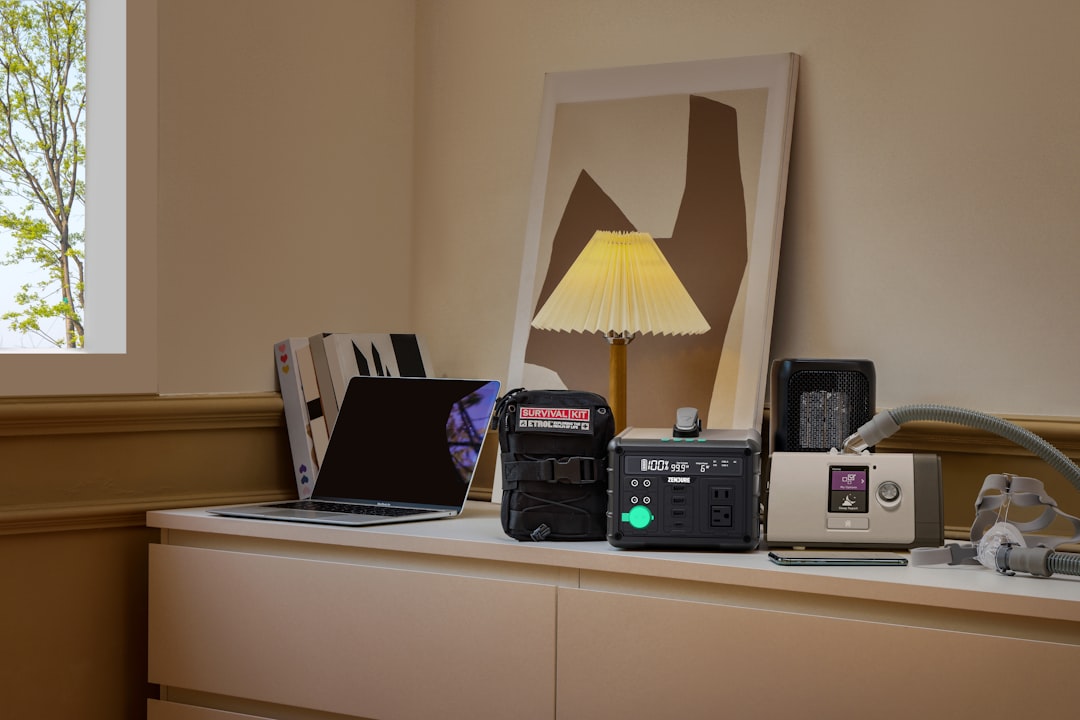
The ideal architecture: a UPS handles instant switchover and daily power conditioning (brownouts and surges happen far more often than full outages), while a portable power station provides extended runtime for long outages. You plug the UPS into the power station, and the power station into the wall. When the grid dies, the UPS bridges the switchover gap, and the power station provides hours of fuel.
Best Smart Home Battery Backup Options in 2026
EcoFlow River 3 — Best Portable Power Station for Most People
The EcoFlow River 3 delivers 256Wh of capacity in a 7.7 lb package that fits on a shelf. At a realistic 100W smart home load (router, modem, switch, hub, and Pi), that’s roughly 2.5 hours of runtime. It charges from 0-80% in about 45 minutes via AC input, so if the grid flickers back on briefly during an outage, you can top up fast.
The X-Boost feature handles surge loads up to 600W, so if your NAS spins up its drives during the outage or your PoE switch powers up all cameras simultaneously, the inverter won’t trip. USB-C Power Delivery at 100W means you can charge laptops and phones simultaneously. At around $180-200, it hits the sweet spot of capacity, features, and price.
Anker SOLIX F2000 — For Extended Multi-Hour Outages
If you live in an area with frequent extended outages (Texas, Florida, rural areas with overhead lines), the Anker SOLIX F2000 is overkill for your smart home alone — but perfect if you want to run a mini-fridge, some lights, and charge devices alongside your network gear. At 2048Wh capacity, you’re looking at 15-20 hours of smart home runtime at a 100W draw.
The LiFePO4 (Lithium Iron Phosphate) battery chemistry is the big advantage here. LiFePO4 delivers 3,000+ charge cycles before significant degradation, which translates to roughly 8-10 years of regular use. Compare that to lead-acid UPS batteries that need replacement every 3-5 years. It’s heavy at 62 lbs, but it’s designed to live in one place — not to be carried around.
If you’re pairing this with a network UPS for instant switchover, this combination covers both the transition moment and multi-hour extended outages beautifully.
APC Back-UPS Pro 1500 — The Reliable Network UPS
The APC Back-UPS Pro 1500 is the workhorse choice for network closets. 1500VA / 900W capacity handles a full networking stack: router, managed switch, modem, NAS, and a small server or two. Runtime at a 100W load is about 90-120 minutes — enough for most outages, and enough time for your NAS to execute a clean shutdown if the battery runs low.
The automatic voltage regulation (AVR) alone justifies the purchase. Brownouts and voltage fluctuations kill electronics slowly over time by stressing power supplies. This UPS conditions the power your gear receives 24/7, not just during outages. It’s the only backup option that actively protects your equipment during normal operation.
The USB data port connects to your NAS for automatic shutdown signaling. Both Synology DSM and QNAP QTS recognize APC UPS units natively and can shut down gracefully when battery drops below a configurable threshold.
Jackery Explorer 500 — Budget-Friendly Portable Option
The Jackery Explorer 500 offers 518Wh capacity for around $300. At a 100W smart home load, you get approximately 5 hours of runtime — a solid middle ground between the EcoFlow’s compact convenience and the Anker’s marathon endurance. It uses a pure sine wave inverter (important for sensitive electronics), has USB-A and USB-C ports, and features a basic LCD display showing input/output wattage and remaining capacity.
The interface is minimal — no smartphone app, no remote monitoring, no fancy features. It just works. For people who want a “plug in and forget” backup solution, that simplicity is an advantage. Build quality is reliable and Jackery has been in the portable power market long enough to have mature customer support.

How to Wire Your Backup Power Correctly
Here’s the actual setup that works reliably, based on years of running smart home gear through outages:
- Plug your modem, router, and core switch into the UPS battery-backed outlets — these are your always-on, non-negotiable devices. The UPS handles the instant switchover and daily power conditioning.
- Put your NAS on the UPS too — configure it for automatic shutdown at 20% battery remaining. Both Synology and QNAP support this natively via USB connection to the UPS.
- Use the portable power station for extended runtime — plug the UPS into the power station’s AC output. The UPS handles instant switchover, the power station provides the hours of runtime.
- Keep critical smart home gear on battery-backed circuits — your hub, Pi-hole, and any automation controllers should be on the UPS as well.
- Label every cable and outlet — when the power dies at 2am, you don’t want to guess which outlet is on backup power and which isn’t.
- Test your setup monthly — unplug the UPS from wall power and verify everything stays up. A backup system that silently failed six months ago is worse than no backup at all because you think you’re protected.
For complete network planning including power placement, our home network wiring guide covers rack design and cable management best practices.
Smart Home Battery Backup — What We Recommend
For most people, the APC Back-UPS Pro 1500 for your network rack plus an EcoFlow River 3 for extended runtime covers 95% of outage scenarios. Total cost is under $400, and your entire smart home stays alive through any outage under 3 hours — which covers the vast majority of residential power failures.
If you live in an outage-prone area and want maximum peace of mind, the Anker SOLIX F2000 replaces the EcoFlow and gives you a day-plus of runtime. Either way, don’t wait until the next storm to set this up. Power outages are predictable in frequency but unpredictable in timing, and the gear you need is affordable enough that there’s no reason to be caught unprotected.
Understanding Battery Chemistry for Smart Home Use
How-To Geek’s UPS buying guide provides excellent coverage of why line-interactive UPS units with pure sine wave output are essential for modern electronics. Modified sine wave UPS units — still common in budget models — can cause issues with sensitive networking equipment and NAS devices.
EcoFlow’s portable power station lineup has become the go-to choice for smart home owners who want serious backup capacity without the complexity of a permanently installed system. Their Delta Pro Ultra pairs with home integration kits that automatically switch your critical circuits during an outage.
Tom’s Hardware’s battery backup coverage regularly tests UPS systems specifically for home server and NAS protection — scenarios very similar to keeping a smart home hub online during brief outages.
Jackery’s Explorer series offers a simpler, more affordable entry point for small-scale smart home backup. A single Explorer 500 can keep your Home Assistant server, network switch, and key automations running for 6-8 hours.
For whole-home battery solutions, Tesla Powerwall remains the benchmark but at a price point that makes sense primarily for homes with solar panels or frequent multi-hour outages. The Enphase IQ Battery is a strong alternative with modular capacity expansion.
Power Budgeting Your Smart Home
The biggest mistake people make with smart home battery backup is underestimating their actual power draw. Here’s a realistic breakdown of what common smart home components consume:
- Network switch (8-port PoE): 15-30W
- Router/modem: 10-20W
- Home Assistant server (Raspberry Pi or mini PC): 5-25W
- NAS: 15-40W (varies wildly with drive count and activity)
- PoE security cameras (each): 3-7W
- Smart locks (each): Negligible except during motor actuation (~5W for seconds)
- Smart speakers/displays: 2-5W each
- Zigbee/Z-Wave hubs: 2-5W
A typical smart home core — router, switch, HA server, NAS, and 4 PoE cameras — draws roughly 80-120W. During an outage, you can extend runtime significantly by shutting down non-essential devices like the NAS and keeping only networking, automation, and security cameras online.
Smart home battery backup systems have gotten significantly smarter in the past year. Modern UPS units can communicate with Home Assistant via USB or network protocols, reporting battery level, estimated runtime, and power status in real-time. This integration lets you create automations that respond to outages automatically — dimming non-essential lights, shutting down unnecessary devices, and sending you a notification when battery drops below a threshold. Network UPS Tools (NUT) is the open-source standard for this, and it’s supported by virtually every major UPS brand alongside Home Assistant, Proxmox, and TrueNAS.
Frequently Asked Questions –
How long will a typical UPS power my router and modem?
A standard router (10-15W) and cable modem (8-12W) draw about 25W combined. An 850VA UPS will keep them running for 2-4 hours. A 1500VA UPS extends that to 4-8 hours depending on battery age and condition.
Do I need a pure sine wave UPS for smart home networking gear?
Most consumer networking equipment (routers, switches, modems) and NAS devices work fine with simulated sine wave output. If you have servers with active PFC power supplies (some Dell and HP servers), pure sine wave is recommended to avoid shutdown issues. The APC Pro series provides pure sine wave.
Can I run my whole home network on just a portable power station?
Yes, but be aware of the switchover gap. Most portable power stations take 10-30ms to switch from wall power to battery. Your router will likely reboot during this transition, causing a brief network outage. Pair with a UPS for instant switchover if uninterrupted connectivity matters to you.
Will my NAS automatically shut down when the UPS battery gets low?
Both Synology DSM and QNAP QTS support USB-connected UPS monitoring out of the box. Configure the shutdown threshold (I recommend 20%) in the control panel, and the NAS performs a clean shutdown before the battery dies, preventing data corruption.
How often do UPS batteries need replacement?
Traditional lead-acid UPS batteries last 3-5 years depending on ambient temperature, number of discharge cycles, and usage pattern. Most UPS units beep or display a warning when the battery needs replacement. Portable power stations with LiFePO4 batteries last 6-10 years or 3,000+ cycles.
If you’re into networking gear jokes and geeky merch, check out Witty Design Finds on Etsy — some fun stuff for the home lab crowd.